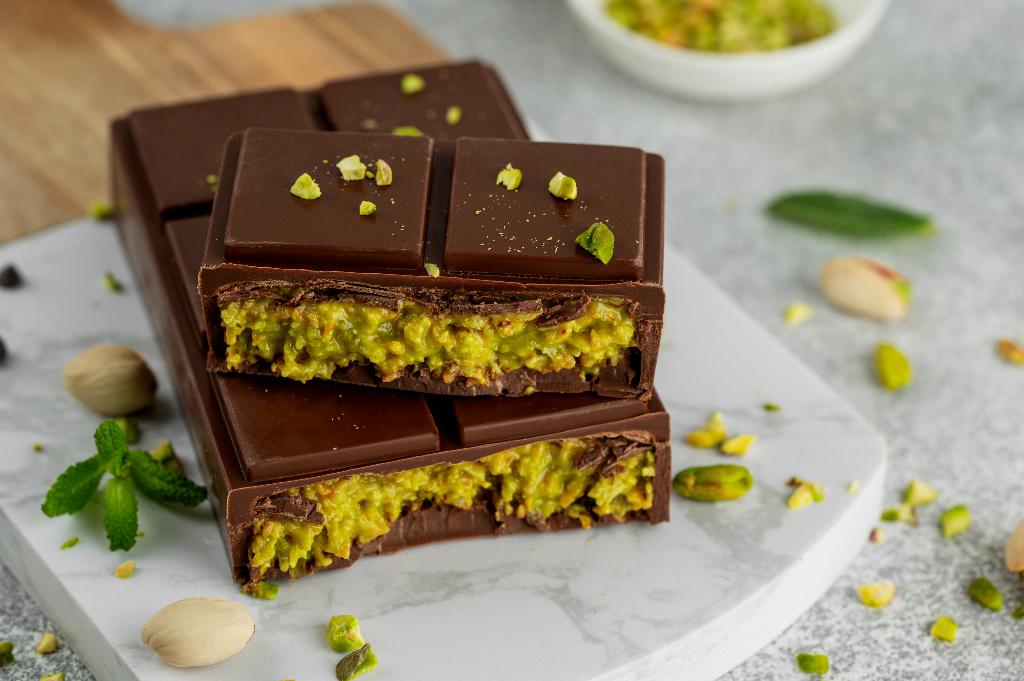
Pistachio Paste Recipe for Dubai Chocolate: How to Get the Perfect Texture and Flavor
Dubai-style chocolate bars are won or lost in the pistachio layer. The filling must look vibrant, feel smooth, and hold its structure inside a thick chocolate shell. In production, that filling often starts with pure pistachio paste, then gets tuned with sweetness, fat balance, and viscosity to match your deposit method, inclusion load (like kataifi), and shelf-life goal.
Below, we break down how pistachio paste is typically made for Dubai chocolate, what texture targets matter most, and the common issues that can show up during molding, storage, and eating quality.
How Pistachio Paste Is Typically Made for Dubai Chocolate
Pistachio paste begins with shelled pistachios selected for color and flavor. From there, the process focuses on refinement. Each stage influences how the paste behaves inside the chocolate bar.
Production generally follows a controlled flow:
- Pistachios are gently roasted to develop flavor without drying out natural oils
- Nuts are cooled fully to stabilize fat content before milling
- Pistachios are ground in stages to reduce particle size evenly
- The paste is refined until it reaches a smooth, uniform consistency
- Fat balance is adjusted to support flow without oil separation
The goal is not a loose spread, but a paste that deposits cleanly, holds shape, and integrates well with chocolate and inclusions.
Pistachio Paste Recipe for Dubai Chocolate Filling
There is no single “one-size” pistachio paste recipe for Dubai chocolate. The right formula depends on how you plan to deposit the filling, how much kataifi you are loading, and what definition you need after set and through shelf life.
Most Dubai-style fillings are built from the same core pieces:
- Pistachio paste (the base): provides flavor, color, and structure.
- Sweetness: added to reach your flavor target without introducing grit.
- Fat adjustment (as needed): used to tune flow for depositing while limiting oil migration into the shell.
- Light seasoning (optional): small amounts of salt or vanilla to lift the nut profile.
A practical way to build it in development is to work in this order:
- Start with pistachio paste as the full base.
- Dial in sweetness gradually, tasting and checking texture as you go.
- Adjust flow last, with minimal fat additions only when the paste will not deposit cleanly at your operating temperature.
- Fold in kataifi and inclusions at the end to protect the structure and keep distribution even.
- Confirm performance with a cut test after set and again after a short room-temperature hold to ensure the layer stays smooth, defined, and stable.
This approach gives you a repeatable “recipe” you can scale, while keeping the controls focused on what actually drives success in the finished bar: deposit behavior, layer definition, and stability.
What Defines the Right Texture for Dubai Chocolate Filling
Texture is the most visible quality in a Dubai-style bar. A pistachio paste that is too coarse or unstable can undermine the entire product.
Key texture characteristics include:
- Fine particle size that eliminates graininess
- Controlled viscosity that allows for clean filling deposits
- Minimal oil to prevent migration into the shell
- Enough body to support inclusions like kataifi without collapsing
A well-made pistachio paste should appear smooth when cut, remain stable at room temperature, and maintain definition from production through shelf life.
Flavor Development Without Overpowering the Chocolate
Flavor balance matters as much as texture. Pistachio paste for Dubai chocolate should be nut-forward but restrained. Over-roasting can introduce bitterness, while under-roasting can leave the paste flat.
Producers typically focus on:
- Consistent roast profiles across batches
- Natural pistachio sweetness without excessive added sugars
- Light seasoning that enhances, rather than masks, the nut flavor
This approach allows the pistachio layer to complement the chocolate shell instead of competing with it.
Common Pistachio Paste Issues and How They Affect the Bar
Even small formulation missteps can create visible defects in finished bars. Use the table below to connect what you see in production to the most common root causes.
| Issue | What You See in the Bar | Why It Matters | Common Root Cause |
| Gritty texture | Rough mouthfeel, sandy cut surface | Reduces perceived quality and premium positioning | Particle size too large, insufficient refining, sweetener too coarse |
| Oil separation | Greasy surface, staining, softened shell edge | Hurts appearance and shortens shelf life | Fat imbalance, temperature swings, weak separation control |
| Paste too firm | Poor deposit flow, voids, uneven fill weights | Slows production and creates inconsistency | Too little fat, paste too cool at deposit, viscosity too high |
| Paste too soft | Slumping, loss of layer definition, inclusions sink | Impacts presentation and bite consistency | Too much fat, paste too warm, not enough body for inclusion load |
Most issues trace back to grind consistency, fat balance, and temperature control, not the ingredient list.
Partner With JSS Almonds for Premium Pistachio Paste for Dubai Chocolate
Many brands start by making pistachio paste in-house for early development. As you scale, consistency becomes the real constraint. Small shifts in paste performance can show up fast as filling that deposits inconsistently, loses layer definition, or separates in storage.
JSS Almonds supplies premium pistachio paste for confectionery applications like Dubai-style bars, where appearance, texture, and repeatability matter. We can customize the paste to your process so you are not forcing your production line to “work around” the filling. You also get flexible formats and quantities that support everything from bench trials to full runs, backed by tariff-proof California supply that helps keep sourcing reliable as you grow.
Ready to dial in your pistachio layer? Contact us now to request specs or a sample.